Warning: is_file(): open_basedir restriction in effect. File(/var/www/virtual/agenda2029.es/spainonline.com/htdocs/sites/all/modules/i18n/i18n_menu/i18n_menu.inc) is not within the allowed path(s): (/var/www/virtual/agenda2029.es/spainonline.com/stage/htdocs:/var/www/virtual/agenda2029.es/phptmp:/usr/share/php/:/var/www/helpers/:/dev/random:/dev/urandom) in Drupal\xautoload\ClassLoader\AbstractQueuedCachedClassLoader->loadClass() (line 82 of /var/www/virtual/agenda2029.es/spainonline.com/stage/htdocs/sites/all/modules/xautoload/src/ClassLoader/AbstractQueuedCachedClassLoader.php).
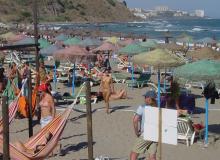
The famous Costa del SOL consists of an agglomeration of former fishermans villages, most to the west of Malaga City. Costa del SOL has a long history that was born from the sea, with the arrival of the first mariners and traders around 2,000 years ago. This has shaped the character of the region ever since, making it a open, welcoming, prosperous place...
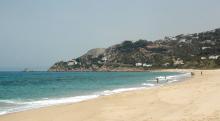
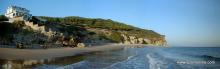
La Costa de la Luz is the atlantic part of the southern spanish coast and beaches, in the provinces of Huelva and Cadiz. Located between the famous Costa del SOL on the Mediterranean and the Algarve coast in Portugal, it was also known as the "forgotten coast".
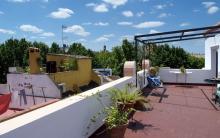
Very nice and quite romantic apartment at only 20 metres from the Alameda de Hércules, the biggest open space in the old center of Seville with a lot of trees, bars and terraces. Great roof terrace to enjoy the sun! Shops nearby and main monuments at only 10-20min walk.
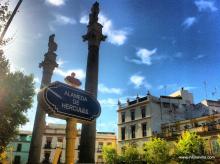
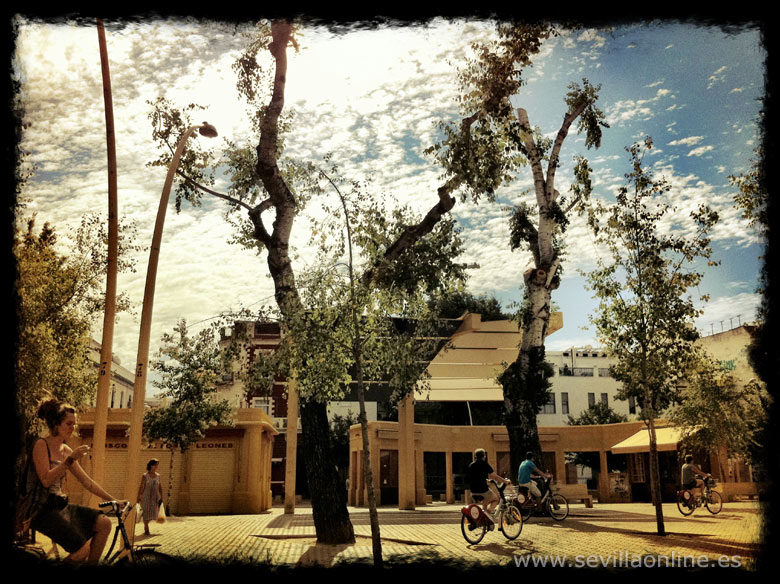
The Alameda de Hércules is a vast open space in the very center of Seville, originally surrounded by Alamo trees, that give the place part of its name - Alameda.
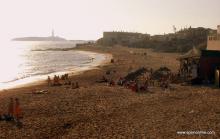
Zahara de los Atunes is situated between Barbate and Bolonia (Tarifa) on the Costa de la Luz (the Coast of Light) and recently becoming a very popular centre of tourism thanks to its magnificent beaches. It is one of the principal charms of Zahara de los Atunes, along with the beautiful sunsets and the possibity to see Africa on the horizon.
La Breña y marismas (marshes) de Barbate Natural Park, situated on the Costa de la Luz, the Atlantic coast of the province of Cadiz, is one of three protected areas in Andalusia that include a maritime zone, thus making them sea-land parks. The park covers a total area of 5,077 hectares of which 3,925 hectares are land and 1,152 marine. Although it is one of the smaller natural parks in Andalusia, it is home to five different ecosystems: ocean, cliffs, pine... Due to its location at the entrance to the Strait of Gibraltar, it is also a support point for the migratory routes of birds in the marshes of Barbate.
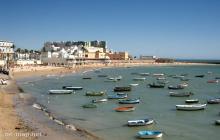
With it’s around three thousand years of history, Cadiz can rightfully claim to be one of the oldest continuously inhabited cities of Europe, where Fenicians, Carthagenes, and of course Romans have had their settlements. It is an open port to the Atlantic and it has it's own beaches on the popular Costa de la Luz (the coast of light).
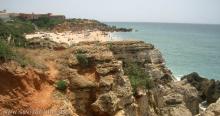
Conil de la Frontera, or just Conil, is a small town on the south-spanish Costa de la Luz (the coast of Light) at some 25 miles south from Cadiz city. The town is built on a coastal plain and bathed by the mild waters of the Atlantic. Conil is a growing tourist destination thanks to it's 14 kms. of magnificent and varied beaches
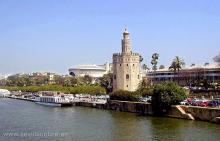
Arenal in Seville, Spain provides the perfect opportunity to catch a bullfight, rent a pedal boat, spend a night at the opera, or explore the naval history of Seville inside the landmark Torre Del Oro and many more.
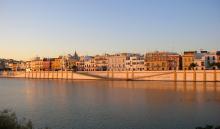
Triana, named after the emperor Trajano is on the other side of the Guadalquivir. The western shore of this river unites the old and new part of Seville. Since Roman times ceramics have been an important part of Triana’s industry.
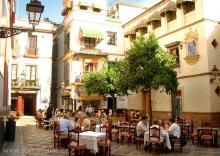
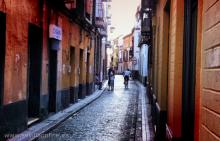
Santa Cruz is the most famous district of Seville. It's justified for its location at the south of the historic city, next to the walls of the Alcazar, surrounded by the main monuments of the city and for its caracteristic narrow and romantic streets.
Escape the tourist track and discover a typical Sevillian district by walking through La Macarena. The Calle Feria is full of activity throughout the morning and has a market selling fresh fish and vegetables. In the afternoon the people of the area can be seen enjoying a drink and eating tapas in the local bars.
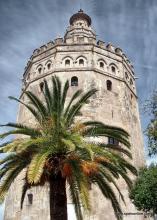
The Gold Tower of Sevillle was one of the last contributions from the Almohade period in Seville. It formed part of the last wall of defence that ran from the Alcázar Palace to the river.
Seville is the capital of Andalusia, the southern region of Spain. It's a beautiful and historic city and it's a great destination for your holidays where sun, light, culture, history, folclore and outdoor life are all to be found under an intense blue and mostly cloudless sky.
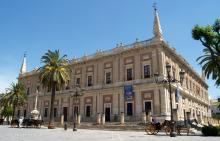
The construction of this building began in the 16th century to be used by traders for their commercial transactions. In 1785, the premises became the headquarters for the General Archives of the Indieswhen structural changes were made to accomodate the numerous files and documents. The archives of the Indies contain references to Spain and her foreign possesions between the 15th and 19th centuries.
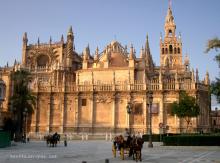
'Let us build a church so big that those who see it will think us mad', that is what the cathedral chapter decided in 1401 when the former mosque of Seville had to be knocked down. It is one of the last Spanish Gothic cathedrals, and the Renaissance style is already evident there. Its impressive size makes it the third largest in the Christian world, after Saint Peter's in Vatican city and Saint Paul's in London.
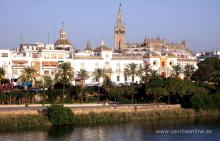
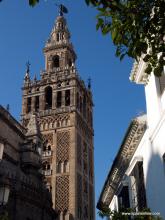
The Giralda is the most emblematic monument of Seville. This Minaret, 76m in height, originally was constructed by the Moors between 1184 and 1197. After the reconquest in 1568 the Christians fitted the minaret with the bell tower. As an emblem of Seville the Giralda forms an elegant and tall silhouette next to the Cathedral.
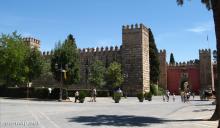
The Alcazar Palace (los Reales Alcazares) is definitly one of the most impressive monuments of Seville. You should not miss it when visiting the city! It is a fortified palace of which the construction was ordered by Abd Al Ramn III in the year 913. The Alcazar palace is considered World Heritage by UNESCO.
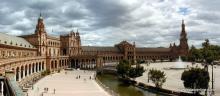
Plaza de España is a semicircular plaza with a diametre of 200 metres which is flanked by two spectacular towers and a bordering lake that are especially worth seeing. Representative of much of the regional architecture, this magnificent construcion is highlighted with polychromatic ceramic tiles.